First Sunday–Monday night of March 1718
The Interrupted Conception
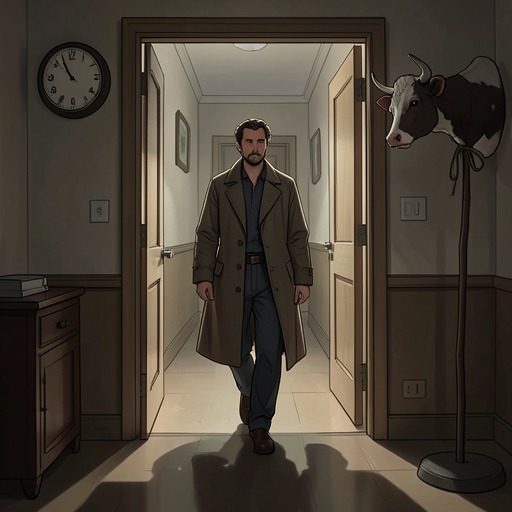
The narrator starts from the moment of his parents' conception, insisting they did not properly take notice of that moment and its consequences. His father, Walter Chand, is interrupted by Elizabeth Morinucks, who asks him if he forgot to wind the clock. He attributes this interruption to it disrupting the animal
March–May 1718, recounted before the birth
The Birth Date Reconstructed
Tristram says he was conceived during the first week of March [1718](entity:time-recall-time-1718-b85a65dd3274), between Sunday and Monday. He calculated the date based on his father's habit of winding the clock every month, a family memorandum recording Walter's journey to [London](entity:location-recall-location-london-420923d4a60a) on the Feast of the Annunciation, and his
Before Tristram’s birth
Yorick Helps the Midwife
There were no midwives near the parish, so the pastor's wife arranged for a local widow to receive training and paid for her license. Pastor [York](entity:location-recall-location-7445402de87b) also contributed financially to the plan, but later the villagers attributed the whole good deed to his wife. York's thin, wheezing horse also had
Years before the main events
Yorick’s Wit Makes Enemies
Joric directly opposed cruelty, hypocrisy, and affectation, often turning his judgments into jokes. His friend [Eugenius](entity:character-recall-character-eugenius-335233f67d4b) warned him that those who were mocked might remember every joke, and one day retaliate against him, no matter how kind Joric intended to be. This warning came true: a
Before Tristram’s birth
Walter’s Theory of Names
Walter Chandy proposed a theory claiming that Christian names have a strong influence on a person's character and fate. He believed some names were auspicious while others were harmful, and he considered the name Tristram particularly contemptible, insisting that no great person had ever used it. He wrote an
Before Tristram’s birth
The Argument of the Whistle
The old family scandal between Dina's aunt and the carriage driver caused Walter and Toby to disagree. Walter repeatedly used this matter to defend his theory, while Toby could not stand to hear about it, and replied with the tune of "Lilibrillo." Tristram called this musical response the
During the Siege of Namur, before the novel’s birth episode
Toby’s Wound at Namur
In Namur, a shell shattered a stone, which flew and hit Toby in the groin. This injury left him unable to move for years; in Tristram's deliberately comic account, it also gave rise to Toby's unusual shyness when facing women. Visitors kept asking Toby to explain the
During Toby’s convalescence, before his return to Shandy Hall
Toby Finds His Hobby-Horse
The map of Namer allowed Toby to explain the siege without getting stuck in lengthy oral descriptions. His research soon expanded into a passionate study of military architecture, the history of sieges, and artillery. When Sergeant Trim proposed building fortifications on Toby's uncle's bowling alley, Toby was delighted. He
During Tristram’s birth, before Dr. Slop reaches the bedchamber
The Sermon Hidden in Stevinus
A family was waiting for the birth of the child when they found a sermon by Jorick in Stevinus's book borrowed from Toby. Trim read it aloud; he heard the description of the suffering of those in the inquisition, especially thinking of his brother [Tom](entity:character-recall-character-tom-268ddde4835d) who was imprisoned there, and
During Elizabeth’s labor
The Green Bag Is Knotted
Dr. Slope's instruments were sent in a green cloth bag, but [Obadiah](entity:character-recall-character-obadiah-2fae13e4cf25) tied the bag's mouth with a tight knot, which Slope could not open. He tried to cut the knot and injured his thumb, so he cursed Obadiah; Walter had him read a bold Latin
During Elizabeth’s labor, shortly after the summons
Slop Falls in the Mud
Dr. Slope rode horse towards Chandos estate, meeting [Obadiah](entity:character-recall-character-obadiah-2fae13e4cf25) on a muddy path running in the opposite direction. Slope lost balance and fell into a mud pit; Obadiah tried to come back to help him but instead splashed more mud on him. The doctor finally arrived at
During Elizabeth’s labor
The Midwife Takes Charge
Walter called in Dr. Slope, but the marriage contract left the decision on the mode of delivery largely to Elizabeth. She insisted on being delivered by a country midwife, while Slope waited as an assistant and complained of his limited authority. Walter defended this partly on the grounds of maternal rights
5 November 1718
The Nose Is Crushed at Birth
During the childbirth process, Dr. Slope's new forceps injured Tristram's nose, flattening it against his face. Walter's grand hopes for his son's body and future turned into sorrow, especially because he believed this injury would harm the child's future and the family's fortune
Immediately after the birth
The Name Becomes Tristram
newborn life is in danger, walter thought of that grand name trismegistus, believing it might compensate for the harm and misfortune the child had already suffered. he sent susanna to convey that name, but she only remembered "tris--what was it?" the parish assistant
The first day after Tristram’s birth
Walter Mourns the Name and Nose
Walter lamented the flattened nose and the name Tristram together, viewing them as disasters connected to his son's future. He believed that childbirth damaged the child's intellectual endowment, and the wrong Christian name would further lead him astray. Toby tried to comfort his brother, but Walter continually
After Tristram’s birth
The First Shandy Birth Hypothesis
Walter explains his theory that a child’s head is compressed during ordinary birth, damaging the brain and its intellectual organization. He believes birth by the feet, or even Caesarean delivery, might preserve a child’s mental capacities.
He uses his older son Bobby’s slow development as evidence, though the theory is an elaborate response to uncertainty rather than a sound explanation. The account satirizes attempts to make a complete system from limited experience.
When Tristram is a young child
The Tristra-Paedia Begins
After Bobby’s death and Tristram’s early misfortunes, Walter begins composing a comprehensive system of education for his surviving son. He intends to control Tristram’s development through carefully chosen teaching, habits, and intellectual exercises.
The project proceeds so slowly that Tristram grows up while its early instructions become obsolete. The delay embodies the novel’s recurring joke that the pursuit of perfect preparation can defeat its purpose.
After Bobby’s death
Trim’s Hat and the Kitchen’s Grief
News of Bobby’s death reaches the household while Walter is calculating a journey. In the kitchen, Trim speaks plainly about mortality, dropping his hat to make the thought of sudden disappearance visible; [Susannah](entity:character-recall-character-susannah-aec42875b2da) and the servants break into tears.
The scene contrasts Walter’s learned consolations with Trim’s embodied eloquence. Tristram presents the dropped hat as proof that gesture, timing, and sympathy can move listeners more powerfully than formal rhetoric.
Several years before Tristram’s birth
Le Fever’s Arrival and Death
Toby hears that a sick lieutenant, [Le Fever](entity:character-recall-character-le-fever-b8848728e1ad), and his son have arrived at a local inn. He sends Trim to investigate, then visits the dying man himself and offers his home, his purse, and his care.
Le Fever dies despite Toby’s kindness, leaving his son in Toby’s charge. Toby attends the funeral with the boy, and later gives him his father’s sword and money to begin a new life.
Spring 1717, after his father’s death
Young Le Fever Joins the Army
Toby raises [Young Le Fever](entity:character-recall-character-young-le-fever-548e8a141517) and arranges his education, teaching him the basics before sending him to school. When news arrives that the emperor is sending an army into Hungary against the Turks, the boy asks Toby for permission to enlist.
Toby gives him his father’s sword and a purse containing sixty guineas, blessing him as he leaves. The episode shows Toby’s generosity in practice and establishes the young man’s later importance as Tristram’s proposed tutor.
When Tristram is five years old
Tristram’s Accidental Injury
A nursery-window accident injures Tristram when [Susannah](entity:character-recall-character-susannah-aec42875b2da) lifts him into the window-seat and the sash falls. She rushes to Toby’s house, while Trim assumes responsibility because his removal of the sash weights for miniature artillery helped make the accident possible.
The mishap adds another bodily misfortune to Tristram’s history and exposes the unintended consequences of Toby and Trim’s military hobby. The novel leaves the precise injury coyly obscured, making the gap itself part of the joke.
Years after the Battle of Steenkirk
The Battle of Steenkirk Recalled
While discussing the nursery accident, Trim recalls the retreat at [Steenkirk](entity:location-recall-location-steenkirk-fe15a8f1684c) and condemns Count Solmes for ordering the foot to halt while the cavalry went where it could not act. Toby agrees that the decision cost lives, and the two men briefly relive the battle in military gestures.
[Yorick](entity:character-recall-character-yorick-987bfe72b410) connects their talk to the decision to bring [Young Le Fever](entity:character-recall-character-young-le-fever-548e8a141517) into the household as Tristram’s tutor. Toby recommends the boy, and Walter agrees to consider him.
Several years after Toby’s return to Shandy Hall
Toby’s Miniature Sieges Flourish
Toby and Trim develop their bowling-green into a miniature theatre of war, building ramparts, bridges, gates, a sentry-box, and a modular model town. They follow real campaigns through newspaper reports, reproducing advances and breaches on their small ground.
The hobby gives Toby continuing pleasure and structure, while Trim’s ingenuity continually enlarges the works. Walter regards the enterprise as extravagant, but Toby sees it as recreation and a service to the nation.
Before Tristram’s French journey
The Strasbourg Nose Causes an Uproar
[Hafen Slawkenbergius](entity:character-recall-character-hafen-slawkenbergiu-43072053ca19)’s tale describes a stranger arriving in Strasbourg with an enormous nose. The town’s residents argue over whether it is real, while clerics, scholars, and citizens turn the question into lectures and controversies.
The stranger’s nose becomes an object of collective obsession. Curiosity empties the city and distracts its inhabitants from their affairs, creating an opening for French forces to take Strasbourg; Slawkenbergius attributes the city’s fate to curiosity rather than to the explanations offered by historians.
After the Strasbourg nose story
Diego and Julia Reunite
[Fernandez](entity:character-recall-character-fernandez-8a2bbfe327b3), searching for the stranger on behalf of his sister [Julia](entity:character-recall-character-julia-dd9a6077f139), finds [Diego](entity:character-recall-character-diego-619035ec498e) and gives him her letter. Diego learns that Julia had regretted sending him away and is dying of grief at Lyons.
He sets out with Fernandez, but the narrative compresses their journey and reunites them with Julia in [Valladolid](entity:location-recall-location-valladolid-6a61893f71cf). Their reunion and the Strasbourg nose episode mock the elaborate conventions of romance while still granting the lovers an emotional resolution.
During Walter’s years of intellectual speculation
The Long-Nose Controversy
Walter collects books on noses and considers competing explanations for their size, including theories that imagination shapes the nose, that the nose shapes imagination, and that nursing affects its growth. He treats these disputes as serious support for his family’s prejudice in favour of long noses.
The theories culminate in [Hafen Slawkenbergius](entity:character-recall-character-hafen-slawkenbergiu-43072053ca19)’s enormous fictional treatise and tale, which Walter reads with delight because it supports both his nose and name systems. The episode parodies learned controversy and the urge to turn every uncertainty into a comprehensive doctrine.
When Tristram is a young child
Walter Debates Tristram’s Breeches
Walter and Elizabeth discuss whether Tristram should be put into breeches, debating cloth, fit, and pockets with long pauses and little practical disagreement. Walter consults ancient dress scholarship but learns more about Roman garments and shoes than about breeches.
The episode turns an ordinary clothing decision into a mock-scholarly inquiry, showing how Walter’s systems magnify minutiae while Elizabeth’s agreeable replies frustrate his desire for precise intellectual engagement.
After the events of the first three volumes
Tristram Travels Through France
With [Death](entity:character-recall-character-death-b8f38d089c7f) imagined as pursuing him, Tristram leaves England and crosses to [France](entity:location-recall-location-france-f5cafc8a8ad4). He travels through Calais, [Boulogne](entity:location-recall-location-boulogne-82a4904ded2d), Montreuil, and onward, repeatedly criticizing travel writers who pretend to describe places they barely saw.
His journey moves by digression, delay, and accident: he argues with post officials, loses his travel notes, and sells his damaged chaise. The travel narrative makes motion itself a source of vitality while turning guidebook conventions into comic targets.
During Tristram’s journey through France
The Lost Tomb at Lyons
Tristram reaches Lyons eager to visit the supposed tomb of [Amandus](entity:character-recall-character-amandus-520750f0b41c) and [Amanda](entity:character-recall-character-amanda-f7c90eb37305), whose story of separation and reunion has lived in his imagination. He learns that the tomb does not exist, and departs disappointed.
The missing monument exposes the gap between sentimental stories and the material world. Tristram’s attachment to the tale nonetheless shapes his experience of Lyons more strongly than the city’s celebrated sights.
During Tristram’s stay in Lyons
Tristram Talks with an Ass
At an inn in Lyons, Tristram pauses to converse with a heavily loaded ass, imagining its thoughts and sympathizing with its burdens. He offers it a macaroon, then tries to lead it inside.
A passerby strikes the animal, and the ass’s pannier catches and tears Tristram’s breeches. The episode combines sentimental compassion with self-mockery, placing the narrator’s concern for an abused creature beside the comic injury to his own clothing.
During Tristram’s departure from Lyons
The Post Office Demands Payment
A [French post-office](entity:organization-recall-organization-8f72a0211c7d) commissary demands payment for a post-road journey Tristram says he will not take, because he is leaving by water. The official insists that the royal ordinance charges travellers who change their plans, and Tristram protests the absurdity of paying for a road he will not use.
He jokes that fickleness itself must be taxable in [France](entity:location-recall-location-france-f5cafc8a8ad4), then concludes that the peace with France has effectively been made on such terms. The exchange turns bureaucratic inconvenience into a political satire and another episode in Tristram’s travel misadventures.
Immediately after the post-office dispute
The Lost Travel Remarks
Tristram discovers that his travel notes have disappeared. He first believes they were stolen, then realizes that he left them in the chaise he sold to a vehicle repairer.
The notes, which he values as a major work, are recovered when he finds them twisted into the chaise-vamper’s wife’s hair. The episode turns loss into an opportunity for a joke about authorship, property, and the distortion of writing in publication.
During the Strasbourg story, before Tristram’s later travels
The False Nose of the Travel Tale
The Strasbourg crowd’s fascination with [the stranger’s nose](entity:object-recall-object-33923ea91efd) expands into scholarly disputes, religious controversies, and competing public lectures. The city’s citizens eventually set out in enormous numbers to meet the stranger, only to find that curiosity has already made them vulnerable to French occupation.
Slawkenbergius frames the episode as a tale with a carefully ordered dramatic structure, then undercuts that authority with digression and uncertainty. The story mirrors Tristram’s own method of making narrative momentum out of interruptions.
After the Treaty of Utrecht, years before the closing chapters
Toby’s Courtship Begins
The [Treaty of Utrecht](entity:event-recall-event-treaty-of-utrecht-c0a6e1dc498d) ends the campaigns that have sustained Toby’s miniature military life. As his enthusiasm for sieges wanes, his attention gradually turns toward [Widow Wadman](entity:character-recall-character-widow-wadman-018fe36c3641), whose house and garden border his own.
Wadman has already fallen in love with Toby and studies his habits from a nearby arbour. Toby, unpractised in love and unaware of her feelings, mistakes her attentions for ordinary conversation and remains absorbed in military matters.
During Toby and Wadman’s courtship
Wadman’s Sentry-Box Attacks
Wadman uses Toby’s military explanations as opportunities to approach him in his sentry-box. She takes his tobacco-pipe, follows his finger across the map, and arranges repeated touches under the appearance of asking about fortifications.
Toby interprets none of these manoeuvres as courtship. His modesty and innocence make him easy to approach but difficult to enlighten, while the narrator describes the encounters through the language of siege warfare.
After the courtship has gathered momentum
Toby Declares His Love
Toby finally tells [Widow Wadman](entity:character-recall-character-widow-wadman-018fe36c3641) that he is in love, using a brief and earnest declaration rather than elaborate courtship. Wadman responds by raising questions about marriage, children, and the costs of family life; Toby answers with the Common Prayer Book and compassion for a mother’s suffering.
Her pointed remark, “A fiddlestick!”, leaves Toby embarrassed and shifts the conversation toward the physical question he does not understand. The scene brings his sincerity into collision with Wadman’s need to know whether his old wound will prevent marriage.
During the final stages of Toby’s courtship
The Map Misleads Wadman
Wadman asks where Toby received his wound, hoping to learn about its location and consequences. Toby takes her question literally, fetches the map of Namur, and carefully marks the site where the stone struck him.
His geographical precision defeats her attempt to obtain an intimate answer. The map turns a personal question into a military explanation, leaving Wadman uncertain about the wound’s effect on Toby’s capacity for marriage.
Near the end of Toby and Wadman’s courtship
Trim’s Story Reveals the Wound’s Meaning
While recounting his brother [Tom](entity:character-recall-character-tom-268ddde4835d)’s marriage and imprisonment, Trim describes his own wartime love for a young Beguine who nursed his injured knee. He insists that despite her care and his growing attachment, he did not fall in love until a later moment of intimate touch.
Toby hears the story as an account of devotion and misfortune, while Wadman listens for evidence about Toby’s wound. Trim’s tale and the corporal’s candid explanation make clear why she is concerned, but Toby still does not understand the practical question she is trying to settle.
After Toby’s declaration, before the novel’s ending
The Proposal Stalls
Wadman asks Toby direct questions about the location and severity of his wound, but he answers through maps, military memories, and literal explanations. The narrator makes clear that she wants to know whether Toby can fulfill the physical expectations of marriage, while Toby believes he has offered her a sincere proposal.
The couple’s incompatible understandings leave the courtship unresolved. Trim and Toby prepare to call on Wadman, but their approach is delayed by Toby’s hesitation and the corporal’s stories; the novel ends without revealing whether the marriage takes place.
Across the novel, with the narrator’s present near 1766
Tristram’s Narrative Runs Ahead
Tristram repeatedly interrupts the family story to address readers, explain his method, announce chapters he may write later, and reflect on the mismatch between lived time and written time. He insists that digression and progress can occur together, and that chapters, blank pages, and missing passages are part of the work rather than defects.
The narrator’s journey through [France](entity:location-recall-location-france-f5cafc8a8ad4) accelerates as he tries to outrun [Death](entity:character-recall-character-death-b8f38d089c7f), but his story continually diverts into memories, theories, anecdotes, and unfinished promises. The fourth volume closes not with the completion of his life, but with the family’s unresolved domestic affairs and another comic interruption: a dispute over whether a parish bull has failed to impregnate [Obadiah](entity:character-recall-character-obadiah-2fae13e4cf25)’s cow.